There is absolutely no confusion in saying that everyone wants to buy a house, a dream home which they can call their own. However, one big confusion among buyers is whether to buy an Under-Construction Property or a Ready to move in Property. Each of these options has its own pros and cons and it is extremely important to be aware about the advantages and disadvantages of Under construction and Ready to move properties. Lets look at them: Negative Points of Under Construction Properties1. Delay in project & Dispute of the Land & Permissions If you know of any project which was delivered on the exact day that it was promised, its rare! Delay in the project for various reasons is one of the top most issue with under construction properties. On an average 2 years is the deadline given by the builders, but it gets delayed and further delayed most of the times. 2 yrs can turn out to be 4 or 5 yrs of wait in a lot of cases and this adds to the frustration of buyers. This delay is caused mainly because of the dispute on the land, cash crunch and most of the times incomplete permissions from authorities. Builders start the construction after obtaining most of the required and most important permissions, but at times there might be few permissions which are still going on, but builders start the construction. So it becomes very important thing for a buyer to check all the required permissions and the ownership details of the lands. This is very true for small builders especially. One important point to note is that even though the house is delayed by just 1-2 yrs and finally comes in your hand, but in a lot of cases promised amenities are given after a long period and some people are still waiting for that swimming pool which was promised in 2001 . 2. You don't get what you see The biggest issue, I repeat – the biggest issue of under construction properties is that you never get what you are promised or have seen as sample flat . Sample flats are built-in a way and decorated in a manner that your heart will met down and you will sell your self to grab that opportunity, and over years you will build so much expectations from your under construction house. But when you really get the possession, you will realise that a lot of things are not up to the mark and not as per the promise done. Sometimes layouts are changed & you may not like the new one. Another issue is over promise in many things. For example – Some builders give false promises that Municipal Corporation Water Supply will be made available in the society after 3-6 months of completion of construction of society, but some builders never fulfill this problem once all the flats in the Society are sold. The builder's objective of selling the flats is fulfilled and then he is not interested in the problems that people face. A lot of times oral promises are done on many things like cost of parking, extra facilities like swimming pool, gym etc and then they are not fulfilled. And at the end, you are in a situation where you can't do anything. Either take it or fight a case against the builder and many hassles that come along. Hence please never agree to any oral agreements under any circumstances – Always insist on written agreements with clear delivery milestones etc. One bad experience from T. Ashok is like this
3. Quality of work may be compromised Another issue is the quality of work that gets done. The quality of the construction material used, Doors and windows fillings can be compromised with, electrical sockets and switches can be of cheap quality, plumbing can go horribly wrong and even the facilities like parking space, children playing area and other amenities might be below the mark or what you expected and when you complain about all this, there will be all sort of explanations like losses in other schemes, cash flow issues and the cost increase by builders and a new series of promises that it will be done soon. For an example watch this video experience for bad quality of construction and unkept promise by Unitech 4. Income tax claim is headache unless you get the possession certificate I hope you knew that you can avail for tax benefits only after you get the possession of the house. Saving tax on the EMI's is one of the big reason why many people plan their house buying, only to realise later that they never thought about this aspect. So if you are going to buy under construction property , be ready to pay rent + EMI and not getting any tax benefit unless you get the possession certificate, and incase the construction gets delayed by few months to 1-2 years, it will be frustrating. Positive Points of Under Construction Properties1. You start paying slowly & conveniently The best part of Under construction properties is that it is affordable for most of the people through a home loan. When I say "affordable", all I mean is that from payment perspective life is easy. You make a down-payment which is generally 20% of the property price and then start making the monthly EMI's each month and this is how a lot of people are able to own the house. Later after few years , a lot of people feel comfortable as their salaries go up, but the EMI's value is very much the same. Even if one is not taking a home loan, they can pay the money in parts as it can be construction linked payment. 2. Choices of floor or location are much wider There are various locations where new projects come up, so the choice in terms of location or which floor you want are generally high. If you are not happy with 12th floor, you can pay more and take the 3rd floor, but in case of ready to move apartments, if 12th is available, then that's all you have. No choice! 3. Good scope of Price Increase Under Construction properties are generally in the outer area's or the non-core part of the city and hence the price appreciation due to future development is good in under construction properties. However this is not true in each and every case. You still have to look at the location and future plans around that area. But the point is that compared to ready to move in apartments, under construction properties have more potential for price increase. Negatives Points of Ready to Move Properties1. A lot of legal work and documentation Generally there is a lot of legal work and documentation required in case of Ready to move properties compared to Under construction, because there are no fresh documentation, but a lot of "transfer" documentation. 2. You need to arrange all the money in one shot for down payment, registration etc In case of Ready to move in properties, all the payment has to be made upfront and all at one time. There is no stages in payment like you have in Under construction properties. So even if you are buying it on home loan, you have to pay all the down-payment, registration charges, stamp duty etc all at one go. 3. Chances of getting duped! In case of ready to move in properties, there is a big risk of getting duped. You have to make sure that you investigate things very properly. There are cases where same property has been sold to more than 1 person. Make sure you hire a good real estate consultant or a good lawyer who can study the documents well and the fine prints. 4. Inflated Price already The price appreciation in case of Ready to move properties is generally lower than Under Construction properties from percentage increase point of view (not absolute increase). Most probably the ready to move in properties which are much older than 5 yrs, a lot of development around them has already happened and the price appreciation has taken place for most what is deserves. Positives Points of Ready to Move Properties1. You buy what you see When you buy Ready to move properties, you exactly get what you have seen. There is no chances of getting duped at least in those things which you can feel and experience. This is not in the case of Under construction properties , because you never see the actual thing , you see samples or the "projections". It's a good idea to talk to the people around or the neighbors about the water/electricity and other things and take their feedback. 2. Immediate relief from Rent & travelling cost A lot of people who are paying very high rent or travelling very far for their work tend to buy the ready to move houses because they want immediate relief from the high rent or travel cost and one can get it in ready to move properties. ConclusionDepending on the pros and cons one has to decide which kind of house will suit them , will it be ready to move or under construction properties. Also all the pros and cons discussed can vary from case to case and the points discussed here are based on a general information and feedback. Can you share what are your experiences and what pros and cons do you think are not discussed here ? |
mGinger

Tuesday, March 13, 2012
Under Construction vs Ready to Move Property – Which one ? : Jagoinvestor


Tuesday, January 24, 2012
Tax Free Bonds Calendar 2012
PFC and NHAI recently came out with tax free bond issues, and two more companies have filed a draft prospectus with SEBI to issue tax free bonds. These two companies are HUDCO (Housing and Urban Development Corporation) and Indian Railways Finance Corporation. Although the dates and details are still not out – I thought of making a tax free bond calendar much like the 80CCF infrastructure bond calendar. The benefit of this type of a calendar is that you can view all the rates and details at one place, and not only use them for future but for past reference as well. It also gives one place for people to leave comments and ask general questions about tax free bond issues. With that in mind – here is a table with details of past as well as future tax free bond issues.
I have taken all the feedback from comments in the 80CCF calendar and increased the number of columns to show more information. The one thing I'd like to say here is that secured doesn't mean any kind of guarantee – it simply means that the company has set aside some assets against this bond issue. If anything happens to the company then those assets will be sold to recover the money for the bondholders. That's all it means – it does not mean a guarantee from the company or the government of India that you will be repaid no matter what. I'll have separate posts on the Indian Railways and HUDCO tax free bond issues when their details are announced, and update this table as well.  |

--
Friday, June 17, 2011
What is your Money Personality ?
| |
Do you know what your money personality is? Now you must be thinking what is the meaning of "Money Personality"? Let me give you a hint! . Ajay earns a lot of money, but his financial life is not that great, the main reason is that he is too conservative with his investments and all his money lies in Fixed Deposits and Cash in the Bank, that's all. This happens due to his internal design of being a "Saver". His life is all about saving and only saving and there comes his money personality. Let's explore more on this. Money PersonalityWe have identified that each one of us have a money personality which we develop during our life and all our actions are driven by our money personality, even our financial life is driven by it and the product we choose, the way we look at each and every aspect is result of what money personality we have. Over the last few years, when we interacted with dozens of clients and thousands of readers like you, we identified that each one of us can be categorized in following money personalities which we will discuss today.
1. SpendersThe first money personality is "Spenders". People who fall in this category have an attitude that "Life happens now". They will spend their money all over which makes them feel that they are "living" the life. They will buy expensive gadgets, eat out at expensive places and will make sure that they are not at all compromising on enjoyment. The behavior also affects their financial life; their savings are not as much as it can be because most of the leftover money at the end of the month is saved. The simple rule of Savings = Income – Expenses is applicable for these people. Most of these people don't have much left in their bank account by the end of the month and they wonder "Where does it all go? " . 2. SaversThe next personality is that of the "Savers". These people believe that life is all about saving and for being prepared for the future. They are not exactly misers, but they appear like misers to others. Whatever can save money for them looks attractive to them. This behaviour also enters their financial life and they invest in anything which claims to save money to them. You can also attach the word "Safety" with these people. They invest in Fixed Deposits , Recurring deposits , bonds , debentures and other investments which are safe avenues. These people like to buy stuff if it claims to save money to them . 3. AvoidersThe third and an interesting category are of "Avoiders". These people are great avoiders, when it comes to taking actions, they will not spend or save, and instead they will just avoid the situation and find all the reasons in life for delaying things and avoiding it. They read, talk and learn about everything, but don't apply it to their life in any way. I personally think that a lot of us are like that. There are even many readers here who are learning things from months/years, but still they have not done anything with their learnings, they just read and feel happy that they know something good, but where is the action? 4. SaintsThe last category is really a different one and often forgotten, that is of "Saints". A person who belongs to this category feels that money is an unimportant thing in life. His beliefs would be "Money is not important thing in life", "More money is more trouble", "Life is all about being Happy and content" and "You just need bare minimum and satisfaction to lead a happy life". While that all is fine, these people over react and don't give much importance to money in life. Most of the people who talk like this are those who really can't make a lot of money and deep down they themselves are worrying for money, but they make sure they show themselves as not-interested-in-money kind of individuals. ConclusionSo which money personality is better than the other and how to make change in your personality? First thing is that there is nothing bad or good about having one of these money personalities. These personalities get into us because of various reasons in life and it's not that easy to change them. What's important is that you need to be aware about your personality and how it's affecting your financial life. Try to find out how your money personality can help in having a financial life which you desire. What do you think about these personalities and which one are you ? |
--
Thursday, June 16, 2011
Reader comment about ICICI Home Loan
Piyush Modi had a very interesting comment on yesterday's post, and this is relevant for people with home loans from ICICI Bank. It seems that he called them up to get something done, and they offered him a lower rate on an existing home loan, and saved him a lot of money! I've been thinking about it, and can't understand why they did that, and I certainly don't know of any other such cases. I thought I'd publish his comment here to see if anyone else has a similar experience, and to let others know about this as well. It will only cost you a phone call, so there is no harm in trying your luck. Here is his comment verbatim: Though this comment is not particularly relevant to this post, but I wanted to leave it and want you to write about it cause I am sure it will help many many of your readers. My dad has a home loan with ICICI Bank which was once taken at a floating rate of 7.5%, and which now stands at 14.5% rate. I recently called up ICICI Phone banking to ask the procedures for a balance transfer to a different bank & I was told that they are running a scheme where existing customers could move to a lower rate of interest. I was skeptical at first, but then went through with the documentation required and apparently its an amazing scheme. Obviously ICICI wont advertise it or inform you, but it is available. My dad's rate has been reset from 14.5 to 10.5% a huge 4% difference. His tenure, which was originally 180 months, and had now gone up to 315 months despite making the EMI repayments for the last 4-5 years (60 months approx) stood slashed at one go to 160 something. Alternatively, one can choose to reduce one's EMI instead of choosing to reduce the tenure. For those wondering how such a drastic reduction in tenure is possible, it can happen. In this case, the total EMI was approximately equal to the interest charged in a year and only a very small amount (4-5%) of the EMI was being used to repay capital. With the fall in the rate charged by 4%, this shifted up considerably to 25-27% of the EMI, and this means that a lot more of the EMi is being used to repay capital instead of just service debt and this leads to drastic reduction in tenure. What were the documentation/formalities required – 1. Cheque for a charge of 0.5% of balance outstanding on the loan+service tax on the same. Now I am not sure whether the scheme is available for all home loan borrowers or a particular category, as also the amount of reduction in rates will be the same for all borrowers or not. But give a call to ICICI bank and just ask. It will save you a tonne of money.
|
| | |
--
Wednesday, June 15, 2011
Don’t confuse yields with interest rates
| |
Last week, a reader pointed me to fixed deposits from Avon Corporation, and my eyes naturally gravitated towards the highest number in the table viz. 14.19% yield p.a. for a 3 year fixed deposit. On the face of it this looks quite high, but that's because your reference is usually a fixed deposit interest rate, which is different from this yield. It is important to understand this difference because there are a lot of private companies that offer fixed deposits, and they usually do advertise the effective yield. I don't write about company fixed deposits a lot, but when I checked a 2009 article about Tata Motors fixed deposit – I saw that they used the same annual yield as well. Usually companies give you two options:
The periodic interest option is usually straightforward, as they advertise the rate of interest you will get for your deposit. However, the cumulative plan becomes confusing because they advertise an interest rate and an annual effective yield. Let's use the numbers given in the Avon example. They say that the minimum investment is Rs. 5,000, tenure is 3 years, interest is compounded quarterly, and the yield per annum is 14.19%. So, what does that mean – are you getting 14.19% interest per year which is then re-invested for you? No, absolutely not. Their brochure tells you that you're getting 12.00% interest rate for the 3 year maturity period, so where does the 14.19% number come from? Since, this is a cumulative option you won't get any interest payments, and get a lump – sum payment at the end of three years. Use the Compound Interest calculator to calculate how much you will get at the end of 3 years. This gives us Rs. 7,128.80 at the end of 3 years. So, for Rs. 5,000, you get interest of Rs. 2128.80 for 3 years. Divide that by 3 to get the annual interest – Rs. 709.43. And (709.43 /5000) x 100 = 14.19%. This is your annual effective yield. ConclusionYou can't compare this 14.19% with the interest rate that banks normally show because that's like comparing apples and oranges. This number is high only because it has been compounded for 3 years, then divided equally by three years, and you use the initial principal of Rs. 5,000 as base. If you were to get a fixed deposit with a bank at 12% for a year, and re-invest that money again for two more years you will get the same effect. I think this post is important for people who are interested in depositing money with companies, so please keep the distinction between yields and interest rates always in your mind, and don't confuse one with the other. |
--
Saturday, April 30, 2011
Is investing in FDs alone enough?
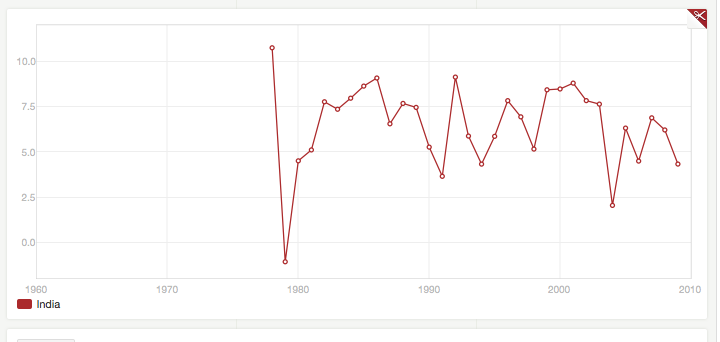
The person estimates that if his daughter were to be married today it would cost about Rs. 5 lacs. He has this 5 lacs today, and wanted to know what would happen if he deposited this in a fixed deposit and took it out after 20 or 25 years. Will inflation eat into the earnings, or will the interest rate from the fixed deposit be enough over such a long term to beat inflation. I can't think of a time in the last five years or so when you could make more in fixed deposits than inflation, but then we all know that people have a short memory and your memory is always colored with what happened recently. This question is one of real interest rate (Nominal Interest – Inflation), and I looked to see if I could find this data over a really long scale. Here is what I found on the World Bank website:
They describe Real Interest Rate as follows:
I will dig deeper into these numbers and their definitions in a later post, but for now I wanted to show that in the past we've had better real interest rates than what we see now. And if oil prices don't spiral totally out of control, we will probably see the end of the high inflation period we have seen recently. That said, the way these numbers are calculated lend me to believe that just putting money in a fixed deposit and earning interest on it will not suffice. So, what should you do? The thought of getting into equities is tempting, but for someone who is looking at fixed deposits as an end - I'd not recommend that. You'd lose too much sleep and probably won't be able to handle the volatility the share market brings with it. Personally, I'd recommend saving more. Yes, I know we're not in a recession any more, and this kind of talk is not sexy these days, but you have to understand that there is risk in equity, and you should be able to handle it. There is no point in getting into shares if you can't handle risks, and I don't think you can handle risk very well if you use the money that you're counting on to conduct your daughter's wedding in the share market. The volatility will drive you insane. Save more, build a buffer, and then if you have money that you think you can lose without losing your sleep over it – enter equities. Remember, it's the good times when you get an opportunity to save more and build wealth – times such as these when everyone is talking about hot stocks are the times when you get carried away and make bad decisions. Stick to the basics; be thrifty, and everything will fall in place. Thoughts? |
--
Wednesday, April 6, 2011
ELSS Mutual Funds: Effect of DTC and Current Status
| There is still a year to go before DTC (Direct Tax Code) kicks in, and there seems to be some amount of confusion in people's minds on how DTC will affect the tax saving ELSS mutual funds. To understand the effect of DTC you need to first know how ELSS mutual funds give you tax benefit. These mutual funds are covered by Section 80C, which mean that the money you invest in these funds is reduced from your taxable income (up to a limit of Rs. 1 lac) and hence you pay less taxes. With that said – let's take a look at how DTC impact on your existing as well as new ELSS purchases. Effect of DTC on your existing ELSS MFsThe funds that you've already bought have given you the tax benefit in the year you bought them, and after the year of purchase there is no tax benefit from them. Given that, you shouldn't be worried about the ELSS funds you have already bought. The only thing I'll add to that is some people choose for the dividend re-investment option, and the re-investment is treated as a fresh investment. This is important because ELSS funds have a lock in period of 3 years, and your new units are locked for a further 3 years. With that in mind, change your dividend reinvestment option to a simple dividend or growth option. ELSS Purchases from now till April 2012Since DTC will kick in from the next financial year, you can still buy them this year and get tax benefit under 80C this year. ELSS Purchases After DTC Kicks InUnder DTC – ELSS mutual funds will no longer enjoy the tax benefits that they currently do. I don't know whether they will still have the 3 year lock in period, but it doesn't make any sense to have the lock in period if they're not going to have any tax benefit. Will DTC affect the performance of the existing funds?There was an interesting comment where a reader asked that since the popularity of ELSS funds is bound to go down, the assets under management are likely to come down, and will that have any effect on the performance of these funds? I can't think of any reason why it will play out like that. If anything, it should be easier for a fund manager to produce better returns because the base is lower. These were some thoughts that came to my mind while answering ELSS related questions here, please feel free to leave a comment if you have any questions or observations on these.  |
--
Wednesday, March 30, 2011
How often does India win when Sachin scores a century?
| There is this thing I keep hearing that Sachin's centuries are not all that lucky for India, and we generally lose when he scores them. A lot of people have this impression, and I thought I'd dig deeper and figure out if there's anything behind this. The data that I found surprised me quite a bit. Sachin's centuries only result in about 69% wins for India whereas Sehwag's 14 centuries have led to 13 wins! Similarly the winning percentage for Ponting, Jayasuriya and Ganguly who have scored many more than Sehwag is much higher as well. Looking at all the data behind these numbers – I see that there is a simple explanation, but I won't spoil the fun for you and let you enjoy this little graphic with a lot of other interesting stats as well. So, you see – it just happens that Sachin has scored more of his centuries against tougher opponents, and while his centuries have in general markedly improved India's winning chances; those chances were so low to begin with that it gives a semblance that India doesn't win as often as it should. I've taken the data from How Stat and CricInfo.  |

| Source: OneMint | |
--
Planning gold purchases for a future occassion
Amit left the following comment a few days ago:
Before I could get to the answer – Niraj Kothari replied to it in a very comprehensive manner, and I think his response has some good insight for people who are planning to purchase gold in the near future for a wedding or some other occasion, so I'm bumping it up to a full post. Even if you're not planning to buy gold – this is a good thing to be aware of.
I think there is value in exploring this option not so much because of the math of it but because of the psychological benefit of setting aside a certain sum every month for a very specific purpose with a jeweler. If you decide to get into a scheme with a jeweler where you invest a sum regularly to get a bonus at the end, then make sure to compare that with at least a bank recurring deposit, and see that it's not too far off. Be it stocks or other assets – regular investing is likely to trump timing the market as far as the retail investor is concerned. Finally – thank you to Niraj for sharing his experience with everyone. |
--
Thursday, February 24, 2011
Just to Relax
Ø No : 1
நிறுத்துங்க சார்.., ஏன் படிச்சிட்டு இருக்கிற பையனை போட்டு இப்படி அடிக்கறீங்க..?
சும்மா இருங்க சார்.., Exam-க்கு கூட போகாம ஒக்காந்து படிச்சிகிட்டே இருக்கான்..!!!
* * * * * * * * * * * * * * * * * ** * * * * * * *
Ø No: 2
உன் பேரு என்ன..?
" சௌமியா "
உங்க வீட்ல உன்னை எப்படி கூப்பிடுவாங்க..?
தூரமா இருந்தா சத்தமா கூப்பிடுவாங்க., பக்கத்தில இருந்தா மெதுவா கூப்பிடுவாங்க.,
* * * * * * * * * * * * * * * * * ** * * * * * * *
Ø No : 3 ( இண்டெர்வியூ.. )
உங்களுக்கு பிடிச்ச ஊர் எது..?
சுவிஸ்சர்லாந்து..
எங்கே Spelling சொல்லுங்க..
ஐயையோ.. அப்படின்னா " கோவா "
* * * * * * * * * * * * * * * * * ** * * * * * * *
Ø No : 4
( புயல் மழையில் ஒருத்தன் பீட்ஸா வாங்க கடைக்குச் போறான். )
கடைக்காரர் : சார் உங்களுக்கு கல்யாணம் ஆயிடுச்சா...?
வந்தவர்: பின்ன.. இந்த புயல் மழைல எங்க அம்மாவா என்னை பீட்ஸா வாங்க அனுப்புவாங்க...!?? அந்த லூசு பொண்டாட்டி தான் அனுப்புனா...
* * * * * * * * * * * * * * * * * ** * * * * * * *
Ø No : 5
நடிகர் Vijay : இனிமே நடிக்கிறதை நிறுத்திட்டு மக்களுக்கு பொதுசேவை பண்ணலாம்னு இருக்கேன்..
நிருபர் : நீங்க நடிக்கிறதை நிறுத்தினாலே அது மக்களுக்கு பண்ற பொதுசேவை தானே சார்..!!
* * * * * * * * * * * * * * * * * ** * * * * * * *
Ø No : 6
டாக்டர் : உங்க கணவருக்கு இப்ப ஓய்வு ரொம்ப முக்கியம்., இந்தாங்க தூக்க மாத்திரை..
மனைவி: ஒரு நாளைக்கு எத்தனை தடவை கொடுக்கணும் டாக்டர்..
டாக்டர்: இது அவருக்கில்லை...உங்களுக்கு..
* * * * * * * * * * * * * * * * * *
Ø No : 7 ( கல்யாண மண்டபம்.. )
"வாங்க., வாங்க..!! நீங்க மாப்பிள்ளை வீட்டுக்காரரா.? பொண்ணு வீட்டுக்காரரா..? "
" ம்ம்.. நான் பொண்ணேட பழைய வீட்டுக்காரர்..!!"
* * * * * * * * * * * * * * * * * *
Ø No: 8
அவர் : நேத்து உங்க காருக்கு எப்படி Accident ஆச்சு..?
இவர் : அதோ, அங்கே ஒரு மரம் தெரியுதா..?
அவர் : தெரியுது...
இவர் : அது நேத்து எனக்கு தெரியலை..!
* * * * * * * * * * * * * *
Ø No : 9 ( கட்சி ஆபீஸ்.. )
தொண்டர் 1 : நம்ம தலைவர் தன்னோட எல்லா சொத்தையும் கட்சிக்கே எழுதி வெச்சிட்டாரு..!
தொண்டர் 2 : சந்தோஷமான விஷயம் தானே..!
தொண்டர் 1 : அட போப்பா.., கட்சியை அவரோட மகனுக்கு எழுதி வெச்சிட்டாரு..!!
* * * * * * * * * * * * * *
Ø No : 10 ( Exam ஆரம்பிக்கும் முன்...)
மாணவன் : டீச்சர் ஒர் Doubt...
டீச்சர் : Exam ஆரம்பிக்க இன்னும் அரை மணி நேரம்தான் இருக்கு.., இப்ப போயி என்னடா Doubt..?
மாணவன் : இன்னிக்கு என்ன Exam..?
* * * * * * * * * * * * * *
No: 11
மகள் : அப்பா., நான் சாதிக்க விரும்பறேன்..
அப்பா : Very Good.., பொண்ணுங்க இப்படிதான் இருக்கணும்.., எந்த துறையைல சாதிக்க போற..
மகள் : ஐயோ அப்பா.., நான் எதிர் வீட்டு பையன் " சாதிக்" -ஐ விரும்பறேன்..
Regards,
Murali
.
__,_._,___
This e-Mail may contain proprietary and confidential information and is sent for the intended recipient(s) only. If by an addressing or transmission error this mail has been misdirected to you, you are requested to delete this mail immediately. You are also hereby notified that any use, any form of reproduction, dissemination, copying, disclosure, modification, distribution and/or publication of this e-mail message, contents or its attachment other than by its intended recipient/s is strictly prohibited. Visit us at http://www.polaris.co.in
Tuesday, February 22, 2011
How does mutual fund NAV affect performance of a fund?
There were two recent comments that prompted me to write this post, and both had to do with mutual fund NAV (Net Asset Value), and how they impact the performance of a fund. The truth is that mutual fund NAVs have no impact on the performance of a mutual fund, and you should ignore the NAV while making a decision to buy a mutual fund, and it shouldn't figure in your decision process at all. One reader asked me if the NAV and performance of a fund are inversely related, and I think that question has its roots in listening to people touting benefits of investing in a mutual fund NFO, and getting a mutual fund at a ten rupee NAV. In reality, there is no relationship between the NAV and performance of a mutual fund. The fund's NAV will have absolutely no bearing on how it's going to perform in the future or how it has performed in the past. The second comment was about the relationship between a dividend payout and the NAV of a mutual fund, and even that doesn't have any effect on performance. The NAV of a mutual fund will adjust according to the dividend payment, but that doesn't mean you stand to gain or lose anything based on when you choose to buy the mutual fund. Let's take an example to understand this. Suppose you want to start up a mutual fund of your own, and give your family members a chance to invest with you. You go ahead and shoot out an email to all family members who you think are interested in it, and ask them how much money they are going to invest with you. Being as smart as you are – you get a lot of responses from your family members, and at the end of your subscription period you get the following sums:
At an exchange rate of 45 rupees to a dollar you convert your 10,000 USD and see that you have Rs. 450,000. So, now your total assets under management are Rs. 9,50,000. You send out a letter to all your subscribers with the information that the fund has collected Rs. 950,000 and you will send them a quarterly report of your progress. At the end of the 3 months, you see that your investments have grown smartly, and that you have grown the money to 10,45,000. Most of your subscribers are happy, but the cousin in US who invested in your fund says that he can't really understand if you did good or bad, and needs a simple way to compare your performance with the Dow. You tell him that the fund made 10% in that quarter, and the Dow gained by 3%, and add that from the next statement onwards you are going to send a percentage gain along with the funds under management as well. Time goes by, and you forget to wish your uncle on his 50th birthday. He does what any loving uncle would do – withdraw his Rs. 50,000 investment from your fund to teach you a lesson. Ouch. You are the honest nephew, so you tell your uncle that his original investment grew by 10% in the 3 months you handled it so you hand him over a check of Rs. 55,000. The market remains stagnant in the next quarter, and the fund doesn't move at all. You shoot an email to your readers telling them that the fund value is now at 9,90,000 and this quarter has been no profit no loss for it. You get a barrage of emails the next morning from your subscribers who ask you what kind of a scammy outfit you're running since the value came down from 10,45,000 last quarter to 9,90,000 this quarter, and you saw no loss at all? You are at a loss on what to do, and decide to call up your good friend Loney who tells you that you need to split up the fund into units, and assign a NAV to the fund. Then tell each of your subscribers how many units they own based on their initial investment, and declare the NAV every quarter instead of declaring the total assets under management. The NAV is not impacted by redemption or new investment, and your current subscribers will better understand your fund performance. Aha – so now you know why you need that blasted NAV in the first place. Now, the next question is what to base it on. You decide that you are going to go the extra mile and make it really easy for your US subscribers to compare your fund's performance with the DOW and make one unit of your fund equivalent to one unit of the DOW! You see that the Dow closed at 12,391.25 on February 18th, and decide that one unit of your fund will also represent that sum. So you divide the initial investment of Rs. 950,000 with 12,391.25 and arrive at 76.67 units. In this case the NAV of 1 unit of your fund is equal to 12,391.25 at the start, and instead of the earlier 95,000 units you just have 76.67 units in your fund. You then tell each of your subscribers how many units they own based on how much money they invested with you. When your aunt sees your email about one unit having a NAV of Rs. 12,391.25 she flips out and calls you asking what's this DOW, and why should she care about it. After listening to your explanation she understands what you're doing but wants you to compare your performance to gold instead of DOW because everyone "knows" gold is the next big thing, and you should at least better that. You try to reason with her, but when she threatens to complain to your mom you go back home, and see that one gram of gold is about Rs. 2,000, so based on that you say that one unit of your mutual fund will be Rs. 2,000 as well, and the total units will now be 450 instead of the earlier 76.67 based on the initial corpus with you. You draft the email informing subscribers of this change, but before hitting the send button decide to take a second opinion from your brother in Delhi. When you call him up and tell him about the Rs. 2,000 NAV – he is livid. He hadn't read your earlier email, and it's good that he hadn't because the only reason he invested in your mutual fund was to get a 10 rupee NAV! What's the point of investing with you if you give him such an expensive NAV? He demands you to give him a 10 rupee NAV immediately. You are at the verge of going insane now, and call me up to ask me what you should do. Unfortunately I'm too busy sending people their infrastructure bond statements and doing the needful so I ask you to call up my buddy Shiv who is an adviser. Shiv tells you to take it easy and keep the NAV at Rs. 10 and placate everyone. It doesn't matter what the NAV is anyway, it's just a number you pull out from a hat. This way at least everyone will be happy. You take this sound advice, and shoot out an email the next day saying that the initial NAV was Rs. 10, and that the fund had 90,000 units, and tell everyone their units individually as well. You wait for angry emails, but no one replies – no news is good news you decide, and smile for the first time wondering how easy it is to pull out any NAV from your hat, and get everyone all riled up for nothing. You can make up any NAV you want at the start of the fund, it doesn't matter if it's 10 or 10,000, so ignore NAVs while making your investing decision.  |
Source: Onemint
--
Monday, February 21, 2011
L&T Infrastructure Bonds Open from 7th Feb to 7th March 2011
L&T has come up with the second tranche of their infrastructure bonds, and this will be open from the 7th Feb 2011 to the 7th March 2011. The bonds are issued under section 80CCF so they will get you an additional tax relief in the form of reduction of taxable salary outside of what you get under Section 80C. L&T Infra bonds have been rated CARE AA+ by CARE which denotes low credit risk. The bonds can be purchased in the physical or Demat form, and the minimum investment needed in the bond is Rs. 5,000. There are two series on offer by L&T and the maturity period of both the series is 10 years. However, there is a buyback option that can be exercised by you at the end of either 5 or 7 years. Here are some details about this issue.
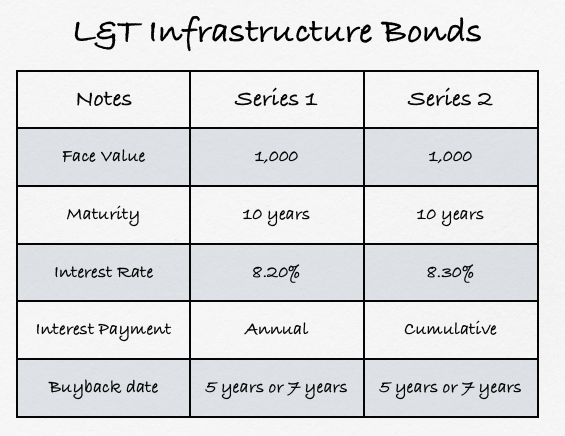 L&T Infrastructure Bonds As you can see above the series which pays annual interest rate has a slightly lower interest payment at 8.20% when compared with the series that pays out cumulative interest. Personally, in the high interest scenario we are in I'd go for the slightly lower interest rate for getting an annual payout, but that's just my preference. You can invest in these bonds through your trading accounts like ICICI Direct, through financial advisers, or you could do it directly by filling out a form, and submitting it in one of the collection centers.  |
| IIFCL Infrastructure Bonds Issue IIFCL is also offering infrastructure bonds under section 80CCF, and their issue started on the 4th February and will close on the 4th of March. IIFCL Infrastructure bonds have a face value of Rs. 1,000 and the minimum investment needed in them is Rs. 5,000. The bonds can be issued in both physical and Demat format, and the issue has been rated AAA / Stable by CRISIL and CARE AAA by CARE, which indicates their highest safety rating. These are secured bonds, and have a lock in period of 5 years after which they will be listed on the BSE. No TDS will be deducted on bonds on Demat form, and for the bonds in paper form no TDS will be deducted if the interest is less than Rs. 2,500. Here are some details of the IIFCL Infrastructure bonds.
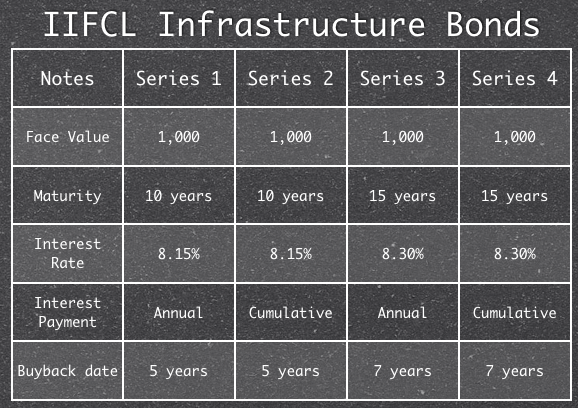 IIFCL Infrastructure Bonds As you can see from the above table there are 4 series, and every series has the buyback option on it as well. The buyback means that even though the maturity period of the bond may be 10 or 15 years, you can get your principal back earlier than that. In series 1 and 2 – you can ask the company to buyback these bonds after 5 years whereas if you opt for series 3 or 4 – you can ask the company to buyback the bonds after 7 years. Since the main benefit of these 80CCF bonds is tax saving, I'm of the opinion that the series with the shorter tenure makes more sense, but this is ultimately your decision and you have to see what makes most sense for your finances. One more thing I'd like to emphasize is that these 80CCF bonds are all under the cumulative limit of Rs. 20,000. If you have already invested in some other infrastructure bond then there is no point in investing in this again since you won't get the additional tax saving.  |
--
Saturday, February 19, 2011
What is the difference between debt and equity products?
This time we're going to take a look at the difference between debt and equity products, and some examples of both.
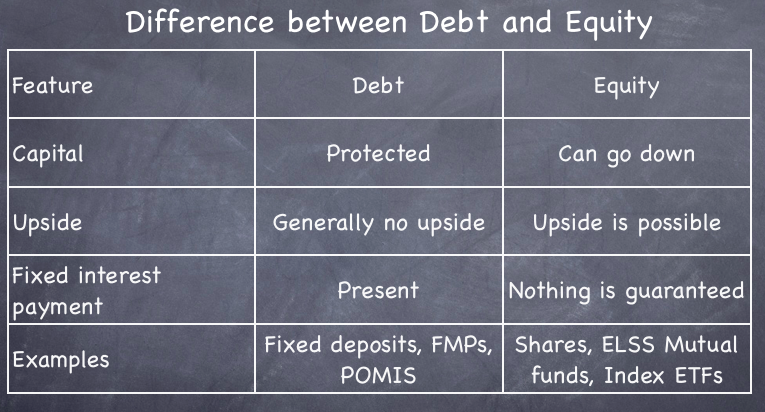 Difference between Debt and Equity Products What is equity?Equity refers to part ownership in a company, and in the Indian context – equity and shares are used inter-changeably. So, if OneMint were a company that had 100 shares in the market, and if you bought 1 share of OneMint – you would be the owner of 1% of OneMint. If OneMint was valued at 1 lakh rupees today, then your share would be worth Rs. 1,000. If 5 years from now – OneMint were valued at Rs. 10 lacs then your share would be worth Rs. 10,000. If however, the company went bankrupt then your share would be worth nothing. Equity products are generally considered to be high risk – high return products for this reason. Examples of equity products: Shares: Shares trading on the stock exchange are the most direct examples of equity products. Equity Mutual Funds: Mutual funds that own shares are another example of equity products. ELSS mutual funds that are eligible for 80C tax savings are a popular example of equity mutual funds. Equity based ETFs: ETFs that are based on shares like Nifty Index Funds are also an example of equity products. What is debt?Debt is loan, and carries a fixed rate of interest, and a promise to repay. Debt is generally safer than equity, and there is generally no upside in it. You get paid the promised interest, and as long as the company (or country) is not bankrupt – you're safe. For example – OneMint could issue debt of Rs. 1 lac at an interest rate of 15% per annum, and as long as OneMint is not bankrupt – you can expect your interest repayment, and also the repayment of your principal. If OneMint goes bankrupt, then first the shareholders are wiped out, which means that your shares in OneMint are worth nothing now, and then the debt is paid off according to the hierarchy of creditors. A secured debt is debt that is secured against a collateral like a building, land, machinery etc. and they have a higher repayment priority than an unsecured debt, which is not secured against any collateral. Examples of debt products: Fixed Deposits with banks are the prime example of debt products. They are extremely safe investments, which have a pre-determined interest rate. The stock of SBI may have wild swings but your fixed deposit with SBI is safe, and won't be affected till something really serious happens. Infrastructure bonds that have recently been launched are another type of debt product as they pay you a fixed interest rate, and the principal is protected as well. They are not as safe as bank fixed deposits, but if any infrastructure company defaults on their debt – that would be an exception rather than the norm. FMPs – These are a special type of mutual funds that have become popular in the past few years, and work like fixed deposits (though not as safe as them). They have become popular due to favorable tax treatment when compared with a fixed deposit, so people don't mind taking the little bit of extra risk. POMIS: Post Office schemes are also debt schemes as they pay a fixed interest, and are also guaranteed. These are very safe instruments. Provident Funds: This is also a debt product, which is quite safe and pays a fixed rate of interest. These are some of the key things that come to my mind when explaining the difference between a debt and an equity product – feel free to add anything that I have missed, and as always – comments are welcome.  |
--
